The Train XI – Vivek Express
Its the 9th chapter of this Train Series
The funny thing is, I never really thought much of it when I first boarded the Lunatic Express to Mombasa back in 2016. That journey took a staggering 19 hours — the same route now covered in just 4 hours by the Madaraka Express. But even with all that time, the experience was rich and unforgettable. It felt like something out of another world — a raw, beautiful kind of travel I never imagined I’d enjoy so much.
I ended up taking that train again just before it was discontinued to make way for the modern Madaraka Express. Something about it stuck with me.
Fast forward through nine memorable train journeys, and now I find myself in the deep south of India, all in pursuit of another train adventure.
You might wonder — why India? Especially when there are now better, faster, and more luxurious ways to travel. But that first experience on the Lunatic Express planted a seed. A fascination that’s been slowly growing — not just with trains, but with the rich stories they carry and the places they connect.
One of the ways I started categorizing these train adventures was by looking at how far a train can go from one end of a country to another — non-stop. That’s how India made it onto my radar. With the Vivek Express ranked among the top 20 longest train routes in the world, clocking in at 4 days of continuous travel, it ticked all the boxes.
And so, here we are.
Welcome to the Indian experience.
#History
Before this, I had only seen glimpses of India’s railway through social media and movies, which gave me a rough idea of what to expect. But it wasn’t until I started researching the railway system that I truly became amazed by its rich and fascinating history. Suddenly, everything began to piece together.
India’s railway story began in the early 1830s with a proposal to build a rail line, primarily to transport raw materials. That means the country has been developing its railway system for nearly 160 years.
Today, India boasts the fourth-largest rail network in the world—a milestone it had already achieved by the 1940s. The Indian Railways is also the eighth-largest employer globally, which shows just how massive and vital the network is. Visiting just a small section of it in 2025 felt like stepping into a living museum.
While the trains are mostly government-run, a major shift happened in the 1950s when the network was divided into zones. That’s when things got really interesting—fans were introduced in trains to help passengers cope with the Indian heat, followed by lighting in the cabins and better accommodation options. Eventually, various classes were introduced: air-conditioned coaches, three-tier coaches, and sleeper class (distinct from second class).
By the late 1870s, the railway had expanded to nearly 15,000 kilometers. And by the 1920s, India welcomed its first electric train. Over the decades, the country has achieved remarkable milestones in rail transport, each one more impressive than the last.
Fast forward to modern-day India, and the railway system stands as a testament to architectural ingenuity, operational precision, and a thriving public transport culture—full of citizens who rely on it daily, with pride and joy.
#TheTrain
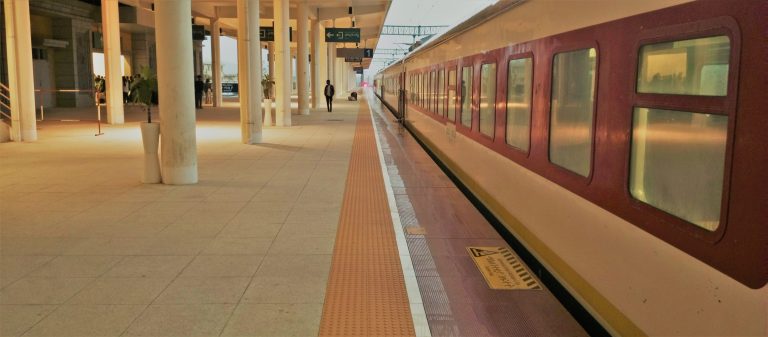
The journey kicks off in the hot, humid city of Kanyakumari and winds all the way to Dibrugarh, Assam. Welcome aboard the Vivek Express (Train No. 15906) — a train that spans 59 halts, 8 states, and takes 4 days to complete its route.

I opted for the highest class coach, which offered some comfort essentials: a proper berth, power outlets, air conditioning, and just enough space to relax, take photos, and soak in the experience.

India has been running trains for over 160 years, so for locals, this is just another commute. But for me, it was an entirely new and fascinating experience. The train reminded me of our own Lunatic Express, though with some key differences. Instead of closed compartments, the spaces are separated by curtains — still private but more communal. And to accommodate the large number of travelers, they’ve added two side berths opposite the usual four in each bay.
There are reading lights, charging sockets, AC in select coaches, and each passenger gets a fresh set of beddings — setting you up for the long haul. While the train isn’t ultra-modern, you can feel the rich history of India etched into its structure as you travel.

One notable difference: unlike our Lunatic Express, which includes a dedicated restaurant car, food here is sold by independent vendors. They hop on and off at different stations, walking through the train offering an endless variety of meals, snacks, and drinks — making it a culinary adventure in itself.
#TheOrganizedConfusion
Before diving into this section, I want to draw your attention to something truly fascinating in India. It’s so remarkable that the Harvard Business School took the time to study it in depth — the ‘Dabbawallah system‘. These lunchbox delivery men are incredibly efficient, managing to deliver around 250,000 meals every single day with almost no errors. What’s even more astounding is that they don’t use any sophisticated tracking systems or labels on the lunchboxes. Instead, they rely on an incredibly organized yet seemingly chaotic method that works like clockwork, often involving trains and precise coordination. They even made a movie about it called the Lunchbox.
Thus, welcome to what I like to call “The Organized Confusion” — otherwise known as the ticketing system.Something Indians have truly mastered is the art of organized confusion. Anyway, in this section i am meant to paint a picture for anyone planning to take any of the long-distance trains in India particularly this one, giving you a rough idea of the fares. But let me tell you, in India, I came face to face with a perfectly choreographed kind of chaos.
Three months before my trip, I started looking into how to book the train. Easy, right? Wrong. Booking a ticket means going through official government websites since the trains are ran by the government — and that requires Indian identification documents. That was Puzzle 1.
Luckily, I found a contact in India who I hoped could help me secure a ticket. But they hit a wall too. Apparently, bookings are reset every 60 days — Puzzle 2. So naturally, I thought, “Alright, I’ll book one month in advance then.” Wrong again. One month before my intended travel date, all the trains — especially the one I needed — were already fully booked- Puzzle 3.
At this point, it felt like trying to decode an alien system. Still determined, I decided to go and sort it out on the ground once I got there.
When I arrived, I learned about something called the Tankal window — a daily 10AM slot where last-minute tickets are released.This window lasts for only 15mins. What?! How do you even begin to connect all these pieces into something logical?How was it fully booked a month earlier and now has space for 15mins?
True to form, I waited for this window for two days, and with the help of a local travel agent, I finally secured a seat.
Indians, to their credit, are completely at ease with this system. I don’t know how — but it works for them.
And that’s why I can’t give you an exact train fare. The price will vary based on when and how you book. But as a rough guide, budget about KES 7,000 one-way for the trip.
#Perspective
Why go through all the hustle? Why bother with the train at all? Is there value for money?
For me, it’s all about perspective — stepping out of your comfort zone to see the bigger picture. It’s about experiencing how other countries solve everyday problems and trying to bring that insight back home.
Take India, for example. Despite its massive population, their public transport systems — especially the trains — somehow work and they are efficient and effective for the common man. Most of the transport infrastructure is government-run, meaning public solutions are being offered for public problems. Contrast that with our situation back home, where we’re at the mercy of cartels who hike fares at the slightest sign of rain or a public holiday.
I’ve personally felt the sting of broken systems — like when I was working on Nairobi’s traffic lights and met nothing but resistance from hostile traffic cops. Then you travel to a place where a single state has nearly double our population, and yet traffic lights are respected and function like clockwork. It really puts things into perspective.
So that’s it for the Train XI experience. I’m already looking forward to the next one, hoping to uncover more stories, more insights — and hopefully bring those lessons back with me.
If you’re planning to take this train and need a little guidance, feel free to reach out: hello@autoblogkenya.com. I’ll gladly connect you to the people who helped make my journey smooth and enjoyable.